Whether you are managing SEO rank tracking, conducting market research, running automated QA tests, or browsing more privately, choosing a reliable proxy provider in 2026 matters more than ever. Modern websites use stricter rate-limiting and geo-fencing systems than ever before, making IP quality, rotation stability, and ethical sourcing critical factors. Below, we compare the 5 best proxy providers in 2026, with their strengths, weaknesses, and starting prices, so you can pick the right fit for your workflow and budget.
Best Proxy Providers Compared: Which One Is Right for You?
Not sure where to start? This side-by-side comparison shows what each provider does best and how much it costs to get started, so you can shortlist the right option in seconds. Tap any provider name to jump straight to its full review.
| # | Provider | Best for | Starting price |
|---|---|---|---|
| 1 | Bright Data | Enterprise scraping and compliance | From $4/GB |
| 2 | Oxylabs | High-speed data extraction and AI projects | From $4/GB |
| 3 | Decodo (ex Smartproxy) | Small businesses, agencies, and marketers | From $3.75/GB |
| 4 | Webshare | Developers and budget projects | Free plan available |
| 5 | IPRoyal | Flexible, low-commitment use | From $1.75/GB (bulk) |
Prices are the lowest published starting rates as of November 2026 and can change, so always check the provider’s pricing page before you buy.
How We Chose These Proxy Providers
There are hundreds of proxy services, so we focused on the factors that matter most when you actually use one:
- IP pool size and locations: A larger pool across more countries means fewer blocks and better geo-targeting.
- Reliability: Published uptime, success rates, and independent reviews from real users.
- Ethical sourcing: Residential IPs should come from users who agreed to share their connection.
- Pricing and flexibility: Clear starting prices, pay-as-you-go options, and free plans or trials.
- Ease of use and support: A simple dashboard, good documentation, and responsive support.
1. Bright Data
Bright Data remains the market leader for enterprises and large-scale data teams that need maximum IP diversity, granular geo-targeting, and strict compliance standards.
- Best For: Enterprise-scale web data collection, brand protection, ad verification, and compliance-focused teams.
- Key Features: Access to a massive 400M+ IP network across 195+ countries, city/ASN/carrier targeting, built-in Proxy Manager, and robust KYC/ethical sourcing compliance.
- Pros: Unmatched IP pool size, industry-leading uptime and success rates, comprehensive documentation, and 24/7 enterprise support.
- Cons: Higher pricing than budget providers; advanced dashboard and compliance verification can have a learning curve for beginners.
- Starting Price: Residential proxies from $4/GB on pay-as-you-go (a promotional rate off the $8/GB list price), with cheaper per-GB rates on monthly plans.
2. Oxylabs
Oxylabs is built for speed and reliability at scale, pairing a huge global proxy infrastructure with AI-powered web scraping APIs that simplify handling complex, JavaScript-heavy targets.
- Best For: High-speed SEO monitoring, e-commerce price intelligence, and AI/LLM training data pipelines.
- Key Features: 175M+ residential IPs across 195+ countries, dedicated datacenter and ISP proxies, and AI-powered Web Scraper APIs with automatic parsing and session handling.
- Pros: Consistently fast response times, high success rates on difficult targets, and strong developer tooling with ready-to-use scraper integrations.
- Cons: Premium pricing geared toward businesses and serious data teams rather than casual individual users.
- Starting Price: Residential proxies from $4/GB, with pay-as-you-go and custom plans available.
3. Decodo (formerly Smartproxy)
Formerly known as Smartproxy, Decodo has evolved into an all-in-one data access platform while keeping the intuitive, self-serve experience that made it a favorite among SMBs and growth teams.
- Best For: Small-to-medium businesses, SEO agencies, social media managers, and solo developers.
- Key Features: Clean self-serve dashboard, residential/ISP/datacenter/mobile proxies, browser extensions, and no-code scraping add-ons.
- Pros: Great balance of price and performance, very easy onboarding without enterprise contracts, and responsive 24/7 live chat support.
- Cons: Fewer enterprise-specific custom SLA options compared to Bright Data or Oxylabs.
- Starting Price: Residential proxies from $3.75/GB on the 3 GB monthly plan, or $4/GB pay-as-you-go. A 3-day free trial with 100 MB is available.
4. Webshare
Webshare is the easiest way to start for developers and testers. It gives you 10 free datacenter proxies with no credit card, and its paid datacenter plans are among the cheapest on the market.
- Best For: Developers, QA engineers, students, and cost-conscious projects needing fast datacenter IPs.
- Key Features: Free starter plan (10 datacenter proxies), customizable proxy lists, SOCKS5/HTTP support, and straightforward API access.
- Pros: Free tier with no credit card required to test, transparent low-cost pricing, and fast setup in minutes.
- Cons: Smaller residential IP pool than top-tier enterprise networks; datacenter IPs are more easily flagged on strict websites.
- Starting Price: Free plan with 10 datacenter proxies and 1 GB of traffic per month; paid datacenter plans start at $2.99/month for 100 proxies.
Our Hands-On Test: Webshare Free Plan
In November 2026, we signed up for Webshare’s free plan ourselves to see how it works in practice. Here is what we found:
- Signup time: About 2 minutes from opening the website to reaching the dashboard, using Google sign-in. No credit card was required.
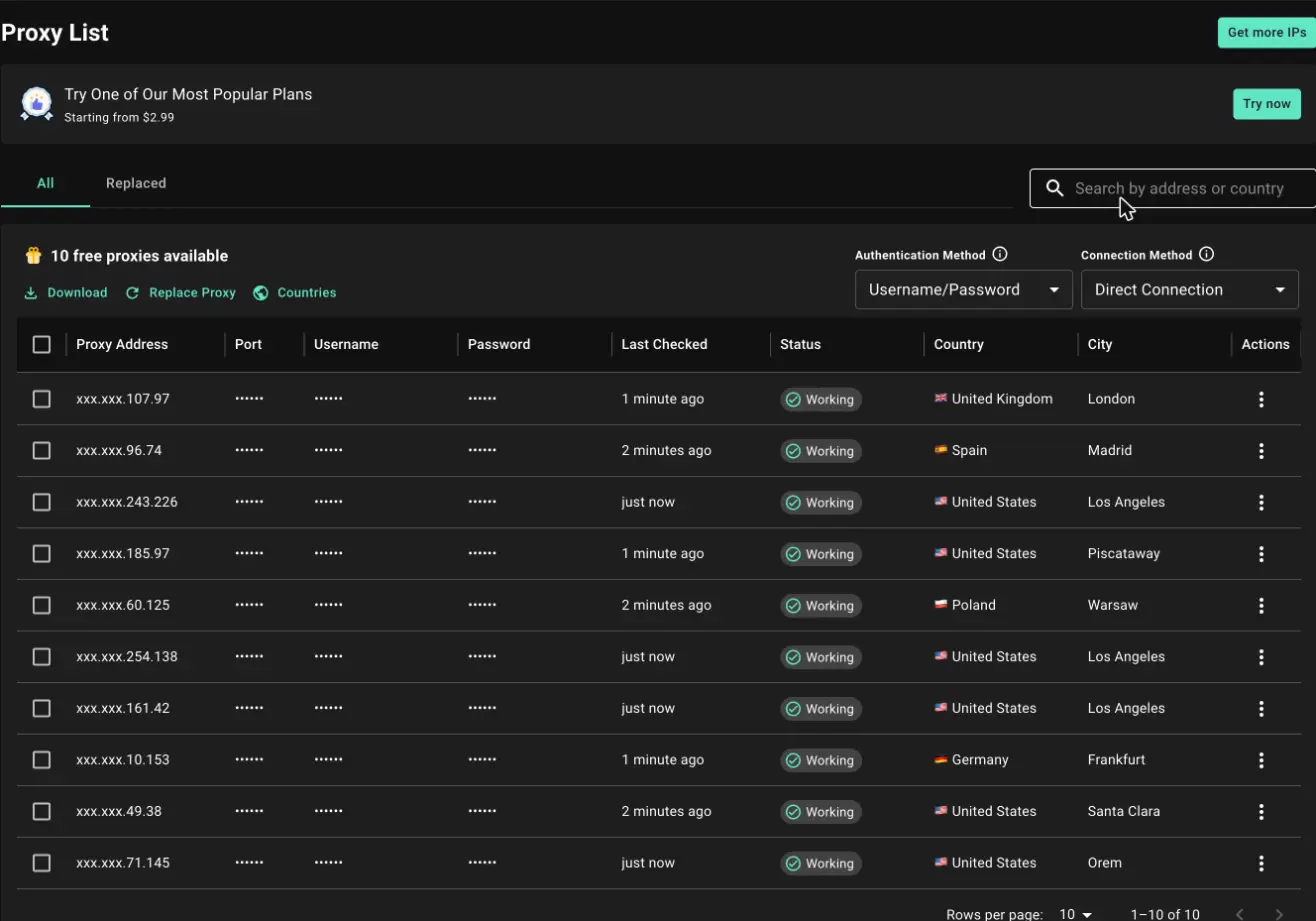
- Proxies ready: All 10 free datacenter proxies were already in the dashboard when it opened, and every one was marked “Working.”
- Locations: United Kingdom (London), Spain (Madrid), Poland (Warsaw), Germany (Frankfurt), and several US cities, including Los Angeles, Piscataway, Santa Clara, and Orem.
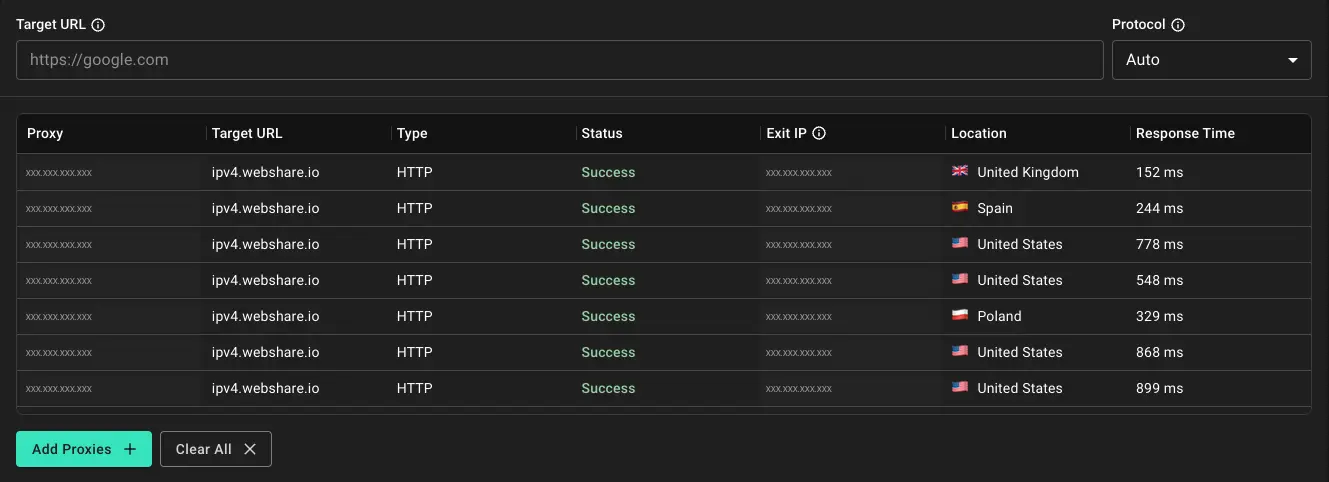
- Speed test: In Webshare’s built-in Proxy Checker, every proxy we tested connected successfully. Response times ranged from 152 ms (United Kingdom) to 899 ms (United States), and the European proxies were the fastest in our test.
Our verdict: Setup was quick and the free proxies worked out of the box, which makes Webshare a great choice for learning, testing a scraper, or light tasks. Just keep in mind that the free plan includes only 1 GB of traffic per month, and response times will vary depending on your own location and the website you connect to.
5. IPRoyal
IPRoyal is popular with freelancers and small teams because of its simple pricing, and especially because the residential traffic you buy never expires.
- Best For: Freelancers, occasional researchers, and users who want flexible pay-as-you-go traffic without monthly commitments.
- Key Features: Non-expiring residential bandwidth, static ISP proxies, 4G/5G mobile proxies, and dual HTTP/SOCKS5 protocol support.
- Pros: Unused residential GBs never expire, low entry cost per GB, and simple dashboard with instant top-ups.
- Cons: Smaller overall IP pool and fewer built-in scraping APIs than Bright Data or Oxylabs.
- Starting Price: Residential traffic from $1.75/GB on larger packages; smaller packages cost more per GB, but the traffic never expires.
Which Type of Proxy Do You Need?
Choosing the right proxy type is just as important as choosing the provider. Here is a quick guide:
Residential Proxies
These use real IP addresses from home internet connections, so websites see you as a normal visitor. They are the best choice for strict sites such as e-commerce stores, search engines, and social media. They are billed per GB and cost more than datacenter proxies. Learn more in our guide to how residential proxies work.
Datacenter Proxies
These come from cloud servers, not home connections. They are very fast and cheap, but websites detect them more easily. Use them for less protected sites, uptime checks, and testing.
ISP (Static Residential) Proxies
These combine the trust of residential IPs with the speed and stability of datacenter IPs, and the same IP stays with you. They are ideal for managing accounts and long sessions.
Mobile Proxies
These use IPs from 4G and 5G mobile networks and are the hardest to block. They are also the most expensive, so they are mainly used for mobile app testing and social media work.
Frequently Asked Questions
Bright Data and Oxylabs are the top choices for enterprises needing massive residential IP pools, high uptime, and strict compliance, while Decodo (formerly Smartproxy) offers an easy self-serve platform for small-to-medium businesses and agencies.
Webshare offers a free starter tier (10 datacenter proxies) and low-cost monthly plans, while IPRoyal provides pay-as-you-go residential traffic that never expires.
Smartproxy rebranded to Decodo as part of expanding into an all-in-one data access and scraping platform while keeping its self-serve proxy infrastructure intact.
Datacenter proxies are fast and affordable for less-protected sites and basic QA checks, but websites with strict rate-limiting or geo-fencing typically require residential or ISP proxies for higher success rates.
Conclusion
The best proxy provider depends on your scale and target websites. Bright Data and Oxylabs lead for enterprise compliance, massive IP pools, and AI-assisted scraping. Decodo offers the smoothest self-serve experience for SMBs and agencies, while Webshare and IPRoyal deliver standout value for developers and pay-as-you-go users. Always test with a small plan first and use proxies responsibly in line with applicable laws and website terms. If you are unsure what is allowed, read our guide on the ethics and legality of using proxies.